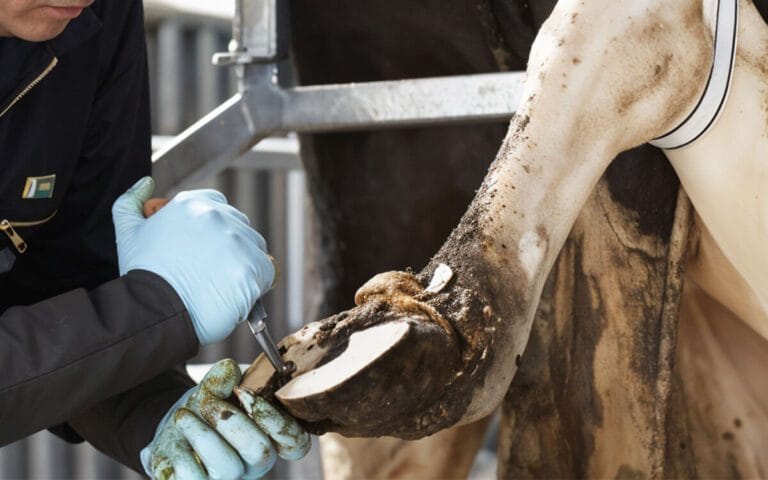


Long hooves in cows are claws whose horn grows faster than it wears down, and they change how a cow stands and walks. Left alone they lead to lameness, discomfort, infections and other serious issues. Many of the causes are reversible if you find them early. As a hoof trimmer, I see the same eight reasons again and again; this post explains each one and what you can do about it.
A cow grows long hooves when her claw horn grows faster than it wears away. The eight common reasons are excessive energy intake, malnutrition, rumen acidosis, curly toe syndrome (corkscrew claw), obesity, genetic predisposition, walking on soft ground and laminitis. Healthy horn grows about 5 mm a month, so regular trimming, a balanced ration and flooring that wears the claws keep hoof length in check.
Why Do Cows Grow Long Hooves?
A cow grows long hooves when her claw horn grows faster than it wears away. Healthy hoof horn grows about 5 mm (3/16 inch) a month, and it takes around 15 months to grow the whole wall from the coronary band to the toe, according to the University of Wisconsin’s Dairyland Initiative. Anything that speeds up growth, slows down wear or makes the horn grow out of shape leaves the cow with long hooves.
Once the hooves get too long, the cow carries her weight differently. The claw angle flattens, more load goes to the heel and the outer claw, and pressure points build up under the pedal bone inside the hoof. That is how long hooves lead to sole ulcers and white line defects, and in the end to lameness.

The 8 reasons at a glance
The eight reasons a cow may grow long hooves, with the signs a farmer or trimmer sees and the first step to take. Each is explained below.
1. Excessive Energy Intake
Excessive energy intake means a cow eats more energy than she needs, either because she overeats or because her ration is too energy-dense. Too much rapidly fermentable carbohydrate is one of the most common nutritional triggers for laminitis, and over time the extra energy also makes cows heavy, which adds load to every claw.
Some animals naturally overeat for survival purposes. If your cows are getting heavy or their hooves keep growing out of shape, we advise talking to a professional nutritionist at your local feed mill about the ration.
Once their hooves get too long, the cows distribute their weight differently, causing unwanted pressure points under the pedal bone inside the hoof. This can result in sole ulcers and white line defects. The hoof also develops grooves and cracks on the outside (the wall area). The deeper the cracks, the higher the chance of an infection and lameness.
2. Malnutrition
Malnutrition means a cow doesn’t get enough feed or her diet is poor, and it can make the outer and inner claws grow at different rates. When a cow’s claws don’t grow at the same rate, they get uneven and out of balance. The difference in claw length forces the animal to put more pressure on one side than on the other.
Malnutrition can be fixed by improving a cow’s diet. Steer clear of unhealthy scraps, mouldy rations and unclean water. Contact a local veterinarian or nutritionist if you’re unsure what’s causing the problem.
3. Rumen Acidosis
Rumen acidosis is a drop in rumen pH caused by feeding too much fast-fermenting feed, and it is closely linked to laminitis and poor horn production. The Merck Veterinary Manual describes the subacute form as repeated periods of rumen pH between 5.6 and 5.2, a risk for dairy cows, feedlot cattle and even cows on lush pasture, and notes its long association with claw horn lesions.
Affected cows often show no clear signs while it is happening. What follows in the hoof is the effect of laminitis: the blood supply to the corium, the tissue that produces horn, is disrupted, the horn comes out soft and weak, and the hooves wear unevenly and grow longer in some areas. Over time you see ‘growth rings’ on the hoof wall and ‘duck feet-shaped’ hooves. Rumen acidosis could be the culprit if you notice shifting or rotating hooves paired with indigestion and a lack of appetite.
Consult the farm’s veterinarian and nutritionist regularly to prevent rumen acidosis. A professional hoof trimmer is often called in to fix the hooves after lameness or overgrowth shows up.
4. Curly Toe Syndrome (Corkscrew Claw)
Curly toe syndrome, or corkscrew claw, is a twisted claw that overgrows because its wall grows faster than normal and curls under the sole. The American Association of Bovine Practitioners (AABP) describes it as a heritable misalignment of the bones inside the claw, seen most often in the outer hind claws of cattle older than 3.5 years, in 3 to 18 percent of animals.
In a corkscrew claw the wall grows faster at the middle and back of the claw, so the claw overgrows, rotates and twists. The lack of support leads to pain and discomfort, the affected claw and joint are often twisted, and the claw ends up much longer than its partner. The overloaded claw is prone to sole hemorrhage, sole ulcers and white line separation.
Possible factors behind corkscrew claw
- Genetics Corkscrew claw is regarded as a heritable trait. The AABP advises against breeding from animals that show its signs at a young age.
- Hot rations Energy-rich rations and nutrition can play a role, alongside claw disease.
- Uneven or unnatural flooring Housing, management and poor claw care can add to it. Walking on uneven or unnatural terrain changes how the claws bear weight.
Three possible factors behind corkscrew claw (curly toe syndrome). Source: AABP Lameness Committee fact sheet.
Curly toe syndrome is hard to correct unless it is caught early. Neglected curled toes cause a cow unnecessary pain and life-long damage. The most common case is the outer claw on the hind leg curling while the inner claw stays flat and normally shaped. On the front feet the order is often reversed: the inner claw curls and the outer claw is normal. The AABP calls this front-foot form, common in cows kept in confinement, an acquired corkscrew claw.
A corkscrew claw needs corrective trimming every 3 to 4 months (AABP): the toe is brought back to the same length as the partner claw, the curled wall is straightened and the two claws are balanced again.

5. Obesity
Obesity puts extra weight on the hooves, so a cow that is too heavy wears her claws unevenly and grows longer hooves. Overweight cows often change their gait and start wearing the hooves wrong. The claws bearing more weight can rotate and wear more in the heel area, causing them to grow longer than they should.
Overconditioned dry cows also lose more of the digital fat pad, the cushion between the pedal bone and the sole, around calving. Managing body condition to 3.0 to 3.5 at dry-off reduces that risk (see our laminitis guide).
If a cow looks obese and has hoof problems, first correct her diet in consultation with your farm’s nutritionist. Then ask your hoof trimmer to balance the claws and correct the long hooves. Make sure the cows have ample walking area and are not overcrowded.
Excessive eating can also cause the rumen acidosis described above. Rumen acidosis and obesity together make a cow’s hoof length and health problems much worse, and can lead to long-term pain and horn damage.
6. Genetic Predisposition
Some cows are genetically predisposed to long hooves: if a cow’s ancestry shows a history of hoof problems, there’s a chance the trait passes down to her calf. The good news is that most cows with a genetic predisposition for long hooves can wear them down by walking on proper flooring and having adequate pen space.
A professional hoof trimmer can help the animal improve its gait and life expectancy, often with minor corrections over time. Our advice is to trim all young stock before calving. This investment saves time and lameness problems in the animal’s first lactation. The Dairyland Initiative gives the same advice: trim heifers one to two months before their first calving.
Genetic predispositions can also lead to obesity, rumen acidosis, curly toe syndrome and the other problems in this post. If that is the case, follow the solution under the matching heading.

“How to trim” Barn Sheet: Learn how to Trim a Cow in 5 steps. Includes helpful diagrams!
Download7. Walking on Soft Ground
Walking on soft ground most of the time lets a cow’s hooves grow long, because soft surfaces wear away less horn than the claw grows. Cows need to walk on harder surfaces that wear their hooves. If the ground is too soft (straw pack bedding, soft pastures, or entire barns with rubber floors), they develop longer hooves, often combined with curly toe syndrome and other unwanted problems. A Dutch study of 12 dairy farms found the flattest claw angles in cows kept on a straw yard (Somers et al., 2005).
This is a fine line: cows love rubber floors and a dirt pack. From its comfort perspective, the cow tells us something through its behaviour. We advise watching for excessive horn growth and booking timely trimming sessions to keep the right balance between horn production and wear.
8. Laminitis
Laminitis is an inflammation of the corium, the blood-rich tissue inside the hoof that produces horn, and it makes the claws grow long and out of shape. When the corium is disrupted, horn quality fails and the pedal bone loses its suspension. After repeated episodes the claw spreads and drops, the toe squares off and the wall carries horizontal ridges, sometimes called hardship grooves. A corium that has been through repeated episodes keeps producing poor horn, so these cows need regular trimming for as long as they stay in the herd.
Laminitis at a glance
- What it is An inflammation of the corium inside the hoof, usually triggered by the ration, the stress around calving, long standing times or another illness such as mastitis or metritis.
- What it does to the hoof The pedal bone drops inside the claw, the horn turns soft and weak, and the claw grows long and out of shape. Sole ulcers and white line disease often follow two to three months later.
- Treatment Acute laminitis needs a veterinarian as quickly as possible, for pain relief and to avoid severe permanent damage. The trimmer then corrects the claws and the nutritionist the ration.
Laminitis in dairy cows: what it is, what it does to the hoof, and how it is treated. More in our laminitis guide.
Laminitis can lead to founder, a condition where the hoof deforms and grows in various directions. It makes the hooves look even longer because they don’t grow evenly. Acute founder needs to be treated by a veterinarian as quickly as possible to avoid severe permanent damage to the inside of the hoof and to ensure proper pain relief. Unchecked and untreated acute problems can be fatal to cows.
(Note: founder is the same thing as laminitis, but many hoof trimmers use the word ‘founder’ for severe forms of laminitis. In the equine world, the word founder is used exclusively.)
How Do You Fix Long Hooves in Cows?
Long hooves in cows are fixed by regular hoof trimming, combined with removing the cause: the ration, the body condition, the flooring or the genetics. Trimming restores a more upright claw angle and balances the weight between the inner and the outer claw. For a Holstein, the toe is trimmed back to about 3 inches (7.5 cm), according to the AABP.
The Dairyland Initiative’s standard schedule for freestall dairy herds:
- Heifers: trim one to two months before first calving.
- Lactating cows: trim once in early to mid lactation (about 60 to 150 days in milk) and once around dry-off.
- High-risk cows that have had claw lesions: trim every three to four months.

The step-by-step treatment of a long claw is in how to treat overgrown cow hooves, and the full trimming method in our cow hoof trimming guide. For timing, see how often cows need their hooves trimmed.
Final Thoughts
Although these conditions can cause extreme discomfort, many can be treated quickly. If you have any concerns, contact a local veterinarian or a professional hoof trimmer to learn what steps you need to take to restore your cows’ hooves. In some cases it’s normal for cows to have longer hooves; they’ll naturally wear down when the animals walk enough on hard ground. Over-trimming by removing too much horn is the other side of the coin, and we definitely want to avoid that human-caused problem.
For more on hoof health and proper hoof trimming, I have created an easily downloadable hoof disease chart with the common hoof diseases in cattle. This reference sheet can help you diagnose hoof problems.
Frequently Asked Questions
Are long hooves painful for cows?
Long hooves are not painful in themselves, but they shift the cow’s weight to the heel and the outer claw. That overload raises the risk of sole ulcers and white line lesions, which are painful and cause lameness. Overgrowth of the outer hind claw is the typical pattern, and it puts that claw at higher risk of claw lesions.
How long should a cow’s toe be?
For a Holstein dairy cow, trimmers bring the front wall of the toe back to about 3 inches (7.5 cm), the length the AABP gives for corrective trimming. Use the white line as a guide and never trim the sole too thin.
Can long hooves wear down on their own?
Sometimes. Cows that walk enough on hard ground wear down extra horn on their own. Claws shaped by corkscrew claw or laminitis do not; they keep growing out of shape and need regular corrective trimming, every three to four months for a corkscrew claw.
- Hoof Trimming Assessment, The Dairyland Initiative, University of Wisconsin-Madison School of Veterinary Medicine, updated 2026.
- An Approach to Corkscrew Claw, AABP Lameness Committee fact sheet, American Association of Bovine Practitioners.
- Subacute Ruminal Acidosis in Cattle and Sheep, Merck Veterinary Manual, updated 2026.
- Development of claw traits and claw lesions in dairy cows kept on different floor systems, Somers J. G. et al., Journal of Dairy Science 88(1), 2005.