

Have you wondered whether switching to sand bedding for cows might be increasing lameness in your dairy herd? If so, you're not alone. One producer told me they converted to sand bedding about a year ago, and it seemed as if their lameness rate was going up. Most of the problems were white line defects, often in two or more feet. Their professional hoof trimmer had tried different trimming methods, the floors were quite wet, the hooves were soft, and the barn was filled to capacity. I have trimmed some herds that are on sand bedding, but I'm certainly not an expert on it, so I'll offer some suggestions rather than answers.
No. Good quality sand bedding does not increase lameness in cows: studies find fewer lame cows in sand-bedded herds and faster healing of claw lesions on sand. If lameness rises after a switch to sand, look at the other causes: soles worn too thin, sharp sand, wet or sloped floors and long waits for milking, and illness such as mastitis or a displaced abomasum (DA).
What Does Research Say About Sand Bedding and Lameness?
Research finds less lameness on sand, not more. A survey of 3,621 cows in 30 Wisconsin herds, published in the Journal of the American Veterinary Medical Association in 2003, found that in winter 33.7% of cows were lame in free-stall herds on other stall surfaces, against 21.2% in free-stall herds on sand. In tie-stall herds the figures were 21.7% against 12.1%.
A study in the Journal of Dairy Science, published in 2008, kept 52 cows in either sand stalls or straw-bedded stalls for at least 21 weeks. Claw problems healed on sand and stayed about the same on straw:
Claw lesions at the start and end of the trial, 17 cows per group (16 on sand at the end). Source: Norring and colleagues, Journal of Dairy Science, 2008, Table 3.
This has also been our experience with sand. In my opinion, it's fair to say that good quality sand in itself is not to blame when lameness goes up. The same study found that cows on sand stayed cleaner and their hock sores healed faster. Cows did lie down a little less on sand (about 11.3 hours a day against 12.5 on straw), and cows new to sand preferred straw at first. Cows that had been kept on sand for 21 weeks used sand and straw stalls equally, so give a herd time to get used to it.
What Makes Good Quality Sand Bedding?
Good bedding sand is fine, clean, and kept deep and level. Let me stress that we are talking about good quality sand: some kinds are very sharp and will cause hoof problems. The Merck Veterinary Manual names abrasive walking surfaces or bedding as a usual factor when cows develop thin soles.
For reference, the sand stalls in the 2008 study held about 20 cm (8 in) of fine sand, with grains of 0.1 to 0.6 mm, and were cleaned and levelled twice a day.
Is the Sand Wearing the Soles Too Thin?
Extra sole wear is the one problem that really comes with sand. Sand can cause a lot of extra wear on the sole, and I have noticed a negative balance between wear and growth: the sole wears away faster than the claw can grow it back.
Merck describes a thin sole as one that flexes under thumb pressure, on a claw whose front wall is shorter than 7.5 cm (3 in). Several feet are often affected, the cow walks tenderly, and the white line area is usually the thinnest part of the sole. That fits the white line defects in two or more feet that the producer above was seeing.
My advice is to keep enough sole thickness in place and play it safe when removing horn on trimming day. The horn is there to protect the corium. If we are dealing with short hooves, we shouldn't trim just for the sake of keeping busy or making the sole “nice and white.” Our post on how often to trim cattle hooves covers the timing.
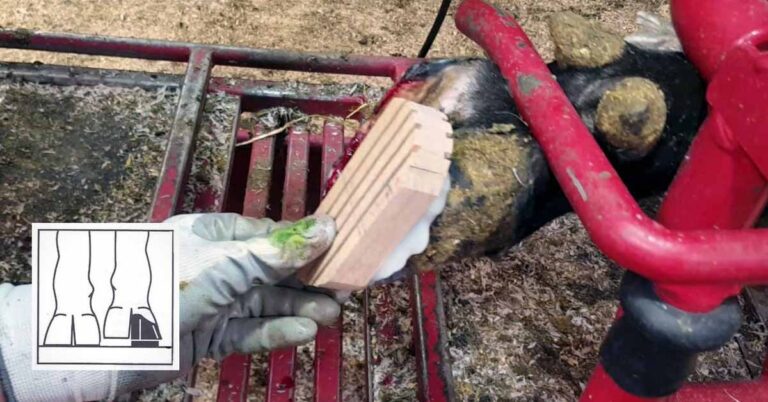
It's also important to give the problem animals relief. Keep them on a softer surface and give the hoof a period of rest. In cases of excessive wear, I also encourage the use of hoof blocks to promote healing. Merck recommends a thin block on the affected claw, a shorter walk for the cow, a deeply bedded place to lie down, and a recheck in 4 to 6 weeks to remove the block.
Are Wet, Slippery or Sloped Floors Adding to the Problem?
Floors and cow flow can cause white line problems whatever the bedding, so check them next.
- Wet floors: The producer I mentioned had a lot of moisture and felt it was making the hooves soft. However, moisture is not the direct cause of such problems. Still, it's always best to keep the floors clean and dry. The drier, the better! Our post on a wet spring and lameness has more on this.
- Slippery floors: With sand on the alleys, I find it hard to believe the floors are slippery. However, slippery floors can result in a higher occurrence of hoof problems, so it is worth a look.
- Slopes and waiting times: Are there slopes in the holding area? How about long waiting times for milking? If cows have to wait longer than they should, or the floors slope too much, hoof problems increase. They will most often appear as white line defects.
Merck's advice for preventing white line disease points the same way: floors with good traction that are neither abrasive nor slippery, and handling that lets cows walk at their own pace.
Could Other Health Problems Be Behind It?
Yes, so look at the herd's other health records before you blame the sand. Have you noticed an increase in other disorders, like mastitis or a displaced abomasum (DA)? They can lead to laminitis, which results in poorer, weaker horn production. These are major causes of lameness and have no direct link to sand bedding.
Merck also lists supplemental copper, zinc and biotin in the feed as a way to increase horn strength. Talk to your nutritionist and veterinarian before you change the ration.
How Can You Test a Fix Before Changing the Whole Herd?
Start with a few cows and keep records. I understand the frustrations and disappointments lame cows cause, but keep up the good work! Tweak a little here and there, and experiment with a small number of animals. You could try something on five cows, and if it works, you can apply it to the rest of your herd.
Locomotion scoring the test cows before and after a change shows whether it helped. And you'll always do well to seek the advice of your veterinarian or hoof trimmer.

Keep track of your herd's records with ease and precision. Web and print-ready options included!
DownloadIf you have any questions or suggestions, whether or not they relate to this article, feel free to contact me through the Contact page.
Sand Bedding for Cows: Common Questions
Is sand bedding good for cows' hooves?
Yes, good quality sand is one of the better stall surfaces for hoof health. A Wisconsin survey found less lameness in herds on sand than in herds on other stall surfaces, and a Finnish study found that claw lesions healed on sand but not on straw. The main thing to watch is extra sole wear.
Can sand bedding cause thin soles?
It can add to them. Abrasive bedding and walking surfaces are a usual factor in thin soles, together with long walks or rough handling. Trim conservatively in sand herds, keep enough sole thickness, and put a thin block on cows whose soles are already thin.
Do cows like sand bedding?
Cows that are used to sand use it readily. In the 2008 study, cows new to sand preferred straw at first, while cows kept on sand for 21 weeks used sand and straw stalls equally. Give a herd time to get used to sand after a switch.
Why do cows get white line problems after switching to sand?
Usually because of something that changed with the switch, not the sand itself: soles worn thin by extra wear, trimming too much sole, wet or sloped floors, long waits for milking, or illness that weakens the horn. Check those before you change your bedding.
- Prevalence of Lameness Among Dairy Cattle in Wisconsin as a Function of Housing Type and Stall Surface, N. B. Cook, Journal of the American Veterinary Medical Association, 2003.
- Effects of Sand and Straw Bedding on the Lying Behavior, Cleanliness, and Hoof and Hock Injuries of Dairy Cows, M. Norring and colleagues, Journal of Dairy Science, 2008.
- Lameness Originating in the Hoof in Cattle, G. Cramer and L. Solano, Merck Veterinary Manual, reviewed 2023, updated 2025.