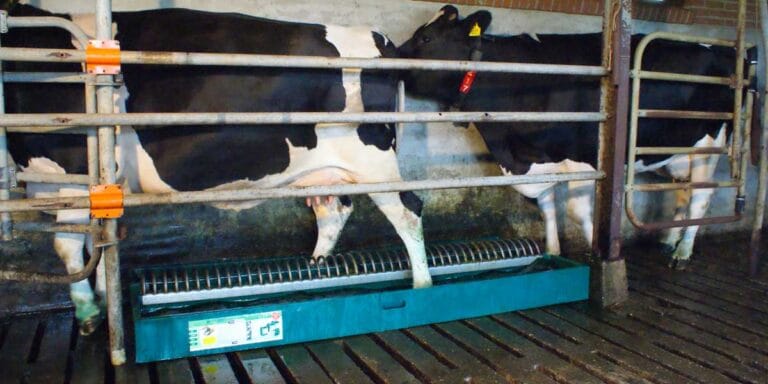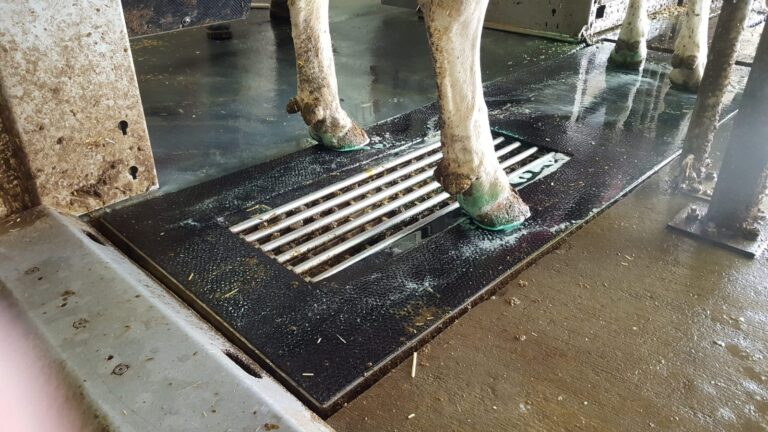


Antibiotic residues in milk are a real risk when you treat claw lesions such as digital dermatitis (hairy heel warts) with an antibiotic spray, paste or wrap. Digital dermatitis is one of the most common causes of lameness on dairy farms, and many treatments still rely on tetracyclines put straight on the lesion. Here is what the research shows about residues, what the Canadian rules say, and how to treat without putting your milk at risk.
Yes, an antibiotic put on a hoof can end up in the milk. A 2019 study found tetracycline in the milk, blood and teat skin of cows treated on the hoof for digital dermatitis, most of all at high doses. In Canada these antibiotics need a vet prescription, and your vet sets the milk withdrawal. A non-antibiotic treatment such as Intra Hoof-fit Gel needs no milk withholding time when used as the label says.
Can Antibiotics on a Hoof End Up in the Milk?
Yes. Antibiotics put on a hoof lesion can leave antibiotic residues in milk, even though the treatment is only on the foot. For years farmers and trimmers assumed a spray or wrap on the heel stayed on the skin, so the risk of residues in the milk was thought to be close to zero. Research has since shown that this is not always true.
Two studies measured it directly:
- Britt and colleagues (1999) treated 28 milking Holstein cows with oxytetracycline, either sprayed on the lesion twice a day for 7 days or once under a soaked bandage. None of the cows had violative residues in their milk, and the authors judged the risk to be low at the doses they used.
- Cramer and colleagues (2019) treated 50 cows with digital dermatitis on two feet with tetracycline, as a paste or as powder under a bandage, at 2, 5 or 25 g per foot. Tetracycline turned up in the milk, the blood and the teat skin in every treatment group. Eight hours after treatment, 11 percent of cows had more than 100 parts per billion (ppb) in their milk, and the 25 g group reached 210 to 244 ppb.
The second study also found tetracycline on the teat skin of every cow sampled. That means a hoof treatment can contaminate the teats and get into the milk that way, not only through the blood. The higher the dose, the more tetracycline showed up and the longer it stayed: in the 25 g group it was found from 8 to 72 hours after treatment.
For scale: Health Canada's maximum residue limit for oxytetracycline in cow's milk is 0.1 ppm, which is 100 ppb. In the Cramer study, the estimated milk withdrawal for single cows ranged from 0 to 70 hours at the 100 ppb level. Diluted in the bulk tank, it was 0 hours at 300 ppb.
What Are the Rules for Antibiotics on Hooves in Canada?
In Canada, tetracycline, oxytetracycline and chlortetracycline need a prescription from a veterinarian. Health Canada moved all medically important antimicrobials for animals to prescription only on December 1, 2018, and the tetracyclines are on that list. Before that, many farmers and trimmers bought and applied them on their own.
Putting tetracycline on a hoof lesion is also extra-label use: the product label does not cover it, so the label gives no milk withdrawal time for it. Your vet decides the dose and how long to keep the milk out of the tank.
The wider worry is resistance. Every time antibiotics are used, bacteria that survive them get a chance to spread, and the drugs we have stop working as well. That matters in animal medicine and in human medicine, which is why governments now want vets to oversee every use. For a disease as common as digital dermatitis, that makes a treatment without antibiotics worth knowing about.
Two ways to treat a digital dermatitis lesion, and what each means for your milk.
How Do You Treat Digital Dermatitis Without Antibiotic Residues?
You can treat digital dermatitis without leaving antibiotic residues in milk by using a non-antibiotic treatment such as Intra Hoof-fit Gel. Its active ingredients are copper and zinc chelate, and its Canadian label says no withdrawal period for meat or withholding time for milk is needed when it is used as directed.
It works in field trials too. In a Dutch trial, the gel healed 92 percent of painful (M2) lesions by day 28, against 58 percent for a chlortetracycline spray (Holzhauer and colleagues, 2011). A Canadian field trial, which Koos Vis co-authored, tested it on Canadian dairy farms as well.
The label protocol is short:
- Day 0: clean the lesion, cover it completely with the gel and put on a bandage.
- Day 3: take the bandage off and apply the gel again, without a bandage.
- Day 7: if the lesion has not recovered well enough, apply the gel once more, without a bandage.
Our full digital dermatitis protocol, with foot baths and herd prevention, is in What Is the Proven Treatment for Digital Dermatitis?
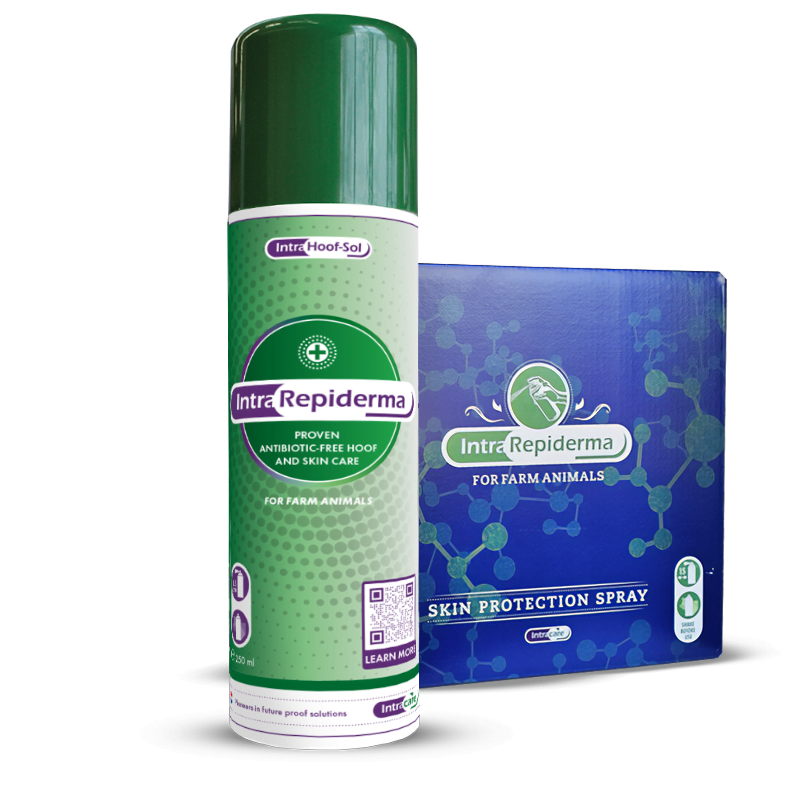
Repiderma is a topical skin care product that supports hoof health, prevents cracks, and protects against minor skin damage between trimmings.
Visit StoreIf Your Vet Prescribes Tetracycline for a Hoof
If your vet does prescribe a topical antibiotic, a few habits lower the risk of antibiotic residues in milk. These follow the advice of the Cramer study and the prescription rules:
- Use the lowest dose your vet prescribes. In the study, the 25 g dose left the most tetracycline in the milk for the longest time.
- Ask your vet for the milk withdrawal time in writing, since the product label does not give one for hoof use.
- Mark the cow and record the treatment, the dose, the date and the end of the withdrawal.
- Ask your vet about testing that cow's milk for tetracycline-class drugs before it goes back in the tank.
- Keep the bandage and the treated foot clean, since the teats can pick up the drug when the cow lies down on it.
Prevention is still the best way to need fewer treatments of any kind. See Foot Bathing and Digital Dermatitis: Prevention, Not Treatment and our digital dermatitis guide.
Antibiotic Residues in Milk: Common Questions
Can a hoof spray cause antibiotic residues in milk?
Yes, it can. A 2019 study found tetracycline in the milk and on the teat skin of cows treated on the hoof for digital dermatitis, and the highest dose left the most behind. An older study at lower doses found no violative residues, so dose and method matter.
Do you need a prescription for oxytetracycline for cattle in Canada?
Yes. Since December 1, 2018, tetracycline, oxytetracycline and chlortetracycline for animals are sold in Canada only with a prescription from a veterinarian.
How long should milk be withheld after topical tetracycline on a hoof?
Your vet sets it, because hoof use is extra-label and the label gives no time for it. In one study the estimated withdrawal for single cows ranged from 0 to 70 hours, depending on the dose and how it was applied.
Does Hoof-fit Gel need a milk withdrawal?
No. Intra Hoof-fit Gel is a non-antibiotic, copper and zinc chelate gel, and its Canadian label says no withholding time for milk or withdrawal for meat is needed when it is used as directed.
- Evaluation of tetracycline in milk following extra-label administration of topical tetracycline for digital dermatitis in dairy cattle, G. Cramer, L. Solano, R. Johnson, Journal of Dairy Science 102(1), 2019.
- Antibiotic residues in milk samples obtained from cows after treatment for papillomatous digital dermatitis, J.S. Britt and others, Journal of the American Veterinary Medical Association 215(6), 1999.
- Curative effect of topical treatment of digital dermatitis with a gel containing activated copper and zinc chelate, M. Holzhauer and others, Veterinary Record, 2011.
- Responsible use of Medically Important Antimicrobials in animals, Health Canada.
- List of Maximum Residue Limits (MRLs) for Veterinary Drugs in Foods, Health Canada.
- Intra Hoof-fit Gel, DIN 02441284, Health Canada Drug Product Database (product label, 2020).