
After trimming thousands of hooves over the years, I have noticed that farms that catch lameness early through regular locomotion scoring save money and keep their cows healthier.
A lame cow costs around $400 per case, considering treatment, lost milk, and potential culling. Farms that make locomotion scoring a routine catch issues early. The difference in herd health and profitability is evident between the two approaches.
In this post, I will share the locomotion scoring methods that enable early detection, explain why some approaches are more effective than others based on real-world farm conditions, and tell you what I saw of the new AI cameras at World Dairy Expo.
Cow locomotion scoring is a standardized method for evaluating cow movement and identifying lameness or mobility issues. It classifies cows on a numerical scale, where lower scores indicate normal movement and higher scores represent increasing lameness severity.

Cow Locomotion Scoring Approaches
There are two ways scoring happens on a farm: a formal score by a trained observer on a set day, and the informal watching you already do at every milking. The best farms use both.
Locomotion score, mobility score, lameness score: three names, one job
You will hear all three terms. In North America most people say locomotion scoring. In the UK, Australia and New Zealand the same exercise is called mobility scoring. Lameness scoring is the plain-language version. They all mean the same thing: watching a cow walk and giving her a number. The scale changes between systems, so always say which one you are using when you compare notes with your vet, your trimmer or a camera system.
Traditional locomotion scoring methods
Traditional cow mobility scoring involves trained observers watching cows walk on a flat, non-slippery surface. The observer evaluates movement characteristics, including back posture, head bobbing, stride length, and willingness to bear weight on all legs.
In Canada, feed mill or breeder representatives typically conduct these assessments. They require consistent criteria and training to effectively identify early onset of mobility issues.
Integrated scoring by farmers
Effective locomotion scoring occurs when it becomes part of daily farm routines. Farmers who continuously observe cow movement during milking, feeding, and other chores develop an instinct for detecting mobility issues.
This vigilance transforms ordinary tasks into diagnostic opportunities. A farmer who watches for shortened strides at the parlour entrance or notices weight-shifting during feeding identifies problems early. These observations become second nature, creating their herd's most sophisticated early warning system.
There is an important caveat: farmers can develop "hoof status blindness." Seeing the same cows daily normalizes subtle movement changes. An outsider often spots lameness issues that the farmer has unconsciously adapted to. This gradual adaptation is natural, but it represents a significant oversight in on-farm assessments.
Integrated scoring should complement, rather than replace, formal assessments conducted by trained external observers or automated systems. Daily observation catches subtle changes that monthly scoring might miss, while external evaluation provides the objectivity that daily familiarity can compromise.

What to Watch in a Cow's Gait
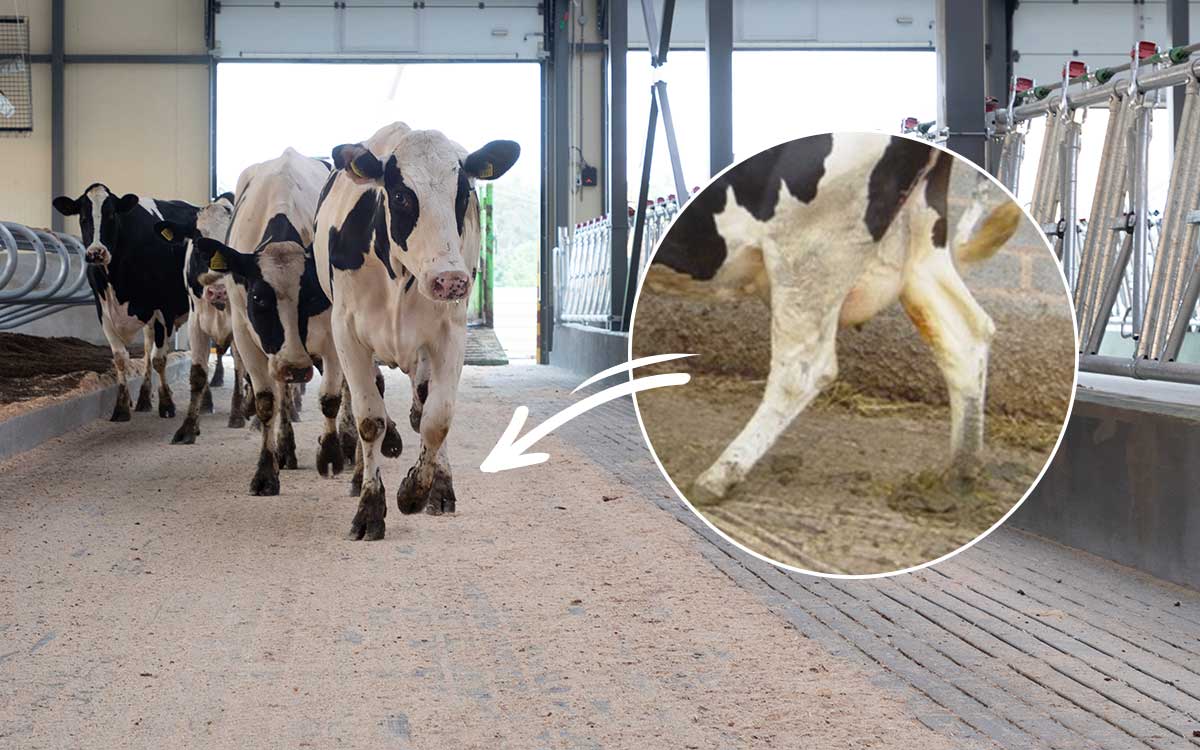
Whatever scale you use, you are reading the same six signs. Watch her on a flat, dry, non-slip surface, from the side and from behind, walking at her own pace.
- Back arch. A sound cow walks with a level back. An arch that shows up only when she walks is the earliest sign. An arch that stays when she stands still means it has progressed.
- Head bob. A cow drops her head as the sound front foot lands and lifts it to take weight off the sore one. A nodding head on a walking cow is a front-foot problem until proven otherwise.
- Stride length and tracking. A sound cow places her hind foot in or close to the print of the front foot on the same side. Short steps, or a hind foot landing well behind the front print, mean she is shortening the stride to protect a foot.
- Swinging a leg out. A cow that swings a hind leg out and around instead of straight forward is keeping weight off the inside or outside claw. Common with sole ulcers and digital dermatitis.
- Weight shifting. Standing at the feed fence or in the parlour, a sore cow rocks from foot to foot or rests one foot on its toe. This is where daily chores do your scoring for you.
- Speed and willingness. The cow that is always last out of the parlour, or that stops on the way, is telling you something before any of the signs above are obvious.
For what those signs usually mean inside the hoof, see our guide to hoof lesions in cattle and the overview of the causes of lameness in cattle.
Cattle Locomotion Scoring Criteria
Different scoring systems exist, but most follow similar principles to catch lame cows earlier for better treatment and prevention. ICAR, the Global Standard for Livestock Data, has a detailed report and guidelines for current lameness scoring methods. Below, I will share the two systems I have found most practical on our farms.
The Sprecher 5-point System
The common method for scoring cow lameness worldwide, the Sprecher 5-point system, is straightforward to use. In 1997, Sprecher and his team developed this system by focusing on observable traits, specifically a cow's back curve when standing or walking. No years of training are required to identify these signs, so farmers, veterinarians, hoof trimmers, and farm workers can use the same scoring method. This consistency enables farms to detect lameness early and make informed management decisions.
If you have a laminated locomotion scoring chart on the barn wall, from Zinpro or a feed company, it is almost certainly this 1 to 5 scale.
- Score 1: Normal. The cow walks and stands normally. Her back stays level, and she does not favour any legs. This is proper movement.
- Score 2: Mildly lame. Standing looks fine, but watch her walk: the back arches up. Gait is still normal. Possible early warning sign.
- Score 3: Moderately lame. The back stays arched, whether standing or walking. You will see shortened steps, favouring one or more legs.
- Score 4: Lame. Always arched back, and she takes deliberate steps. There is a clear favouring of affected feet. No mistaking this one.
- Score 5: Severely lame. Will not put weight on the bad foot. May hold the leg up or barely touch the ground.
This system works in real farm conditions. Once you know what to look for, scoring becomes second nature. This provides farms with a reliable method to track their herd's mobility.
Video: the Sprecher 1 to 5 scale in motion, from Dairy Australia and Zinpro.
The Australian/New Zealand Mobility System
This four-point system was created for working dairy farmers. The developers recognized that most farmers have the experience to spot mobility problems. They needed a simpler framework to make those observations consistent and actionable.
This system prioritizes practicality over memorizing detailed criteria for back arch angles or stride measurements. Farmers focus on one question: how easily is this cow moving?
- Score 0: Moves freely. The cow walks with normal, even steps. There is no hesitation or adjustment in her movement.
- Score 1: Uneven movement. Something is off. A hitch in her step or subtle favouring, but she is still mobile.
- Score 2: Obviously lame. The cow is limping due to a problem with her leg or foot, indicating that she has difficulty moving.
- Score 3: Severely restricted. The cow struggles to move and does not put weight on the affected limb.
The system's strength is removing the guesswork that can paralyze farmers using complex scoring methods. A dairy farmer who has worked cattle for years knows when a cow "doesn't look right." This system gives them the confidence to trust their instincts and act on them.
Video: the 0 to 3 mobility scale as DairyNZ teaches it.
The two scales side by side
Herd-i, which I describe below, scores on the 0 to 3 scale.
Challenges with Traditional Mobility Scoring
Locomotion scoring is effective on all farms, but several factors impact its accuracy and consistency.
Getting Better at Spotting Lameness
Training significantly impacts lameness scoring. The good news is that you improve by working with more cows. After scoring about 200 to 300, you will be reliable with any point system.
Even experienced people need refresher training once or twice a year. It is easy to change how you score without realizing it. To maintain progress, mix hands-on practice with online sessions.
Making It Work on Your Farm
Right after milking, scoring will fit naturally into your routine without disrupting cow flow. When their udders are empty, cows with sore feet show lameness more clearly after milking, making this the ideal time for assessment.
Dealing with Larger Herd Problems
Large farms need to plan and train multiple people to divide the work. Surface conditions, lighting, and cow flow affect scoring accuracy. The ideal setup has flat, non-slip surfaces with good visibility, but most farms can make it work. If your alley floors are part of the problem, see our note on slippery barn floors.
Maximizing Scoring Frequency
Daily whole-herd scoring is not practical for most operations, but farms can maximize early detection by combining scheduled formal scoring with ongoing informal observation during routine tasks. This approach captures both systematic assessment and subtle changes that familiarity with the herd can reveal.

Advancements in Cow Mobility Assessment
Several companies are working to modernize mobility scoring with cameras, sensors and AI. This is still developing, and I want to be upfront: I have no ties to any of these companies, and I have not worked with these systems on a farm myself. But at World Dairy Expo in Madison we stopped by two of them, and I was impressed by both.
Camera Systems We Saw at World Dairy Expo
Herd-i has a camera that scores how every cow walks as she leaves after milking, several times a day. It scores her on the same 0 to 3 scale as the Australian/New Zealand Mobility System I described above. The farmer sets the thresholds and gets a watch list of the cows that need a closer look.
PediVue, from Hoofcount, has a high-speed camera at the footbath exit that photographs each hoof as the cow walks out. It sorts what it sees into active digital dermatitis (DD), chronic DD, or no visible lesion, and gives the farmer a treatment list that tells you which cow and which foot. It also reminds you when it is time to check her again.

How These Cameras Learn
A camera does not know what a lame cow looks like on its own. At the start, people who know what they are looking at go through the footage and score each cow themselves, the locomotion score or the DD stage. Those approved scores go into the AI that runs the camera, and the more approved data it gets, the fewer mistakes it makes and the more you can trust what it tells you.
That is why these companies are getting their systems onto farms right now. Every farm adds more approved data, and that is what makes the system accurate for the farms that come later. It also means the camera is only as good as the people who taught it, so the scoring skills in this article still matter.
Other Systems on the Market
Computer vision systems monitor how cows move and detect problems early. GEA's CattleEye solution uses a camera and AI software to score each cow's mobility as she walks by, without tags or anything on the cow. These cameras detect subtle changes in a cow's gait that may be overlooked.
Pressure walkways demonstrate how each cow distributes her weight as she steps across. If she favours a foot, the system knows immediately and can identify which leg is bothering her.
Wearable monitors on collars or legs track lying time and step patterns. Smartbow's system flags abnormal cow movement, providing an alert before changes become apparent.
3D cameras map a cow's movement, accurately measuring her back position and stride length. Cargill's Dairy Enteligen platform aggregates this data for trend analysis.
What makes this technology valuable
- Continuous monitoring instead of monthly checks.
- Consistent measurements regardless of who observes.
- Catching problems while they are manageable and resolvable.
- Building a history to spot trends before they become widespread issues.
- Everything links to your farm management software.
AI Does Not Trim a Cow
I think AI will become a management tool on dairy farms, the same way milking robots and heat detection systems did. Picture how it will work. The sort gate pulls one cow aside, and the report tells you there is an early M1 lesion on one particular foot. You know which cow, which foot, and what to look for, before she ever shows a limp.
But somebody still has to act on that list, with the knowledge and the tools to put her in the chute and fix what is there. The real win is timing. Catch it early and the lesion is small and easier to fix, and you stay away from the chronic cases. A list that sits on your phone for a week does not help the cow.
Whatever finds the cow, the camera or your own eyes, write down what the trimmer finds on her. Our free record-keeping sheet gives you a place to do that, cow by cow, so you can see over time whether your protocol is working. And until there is a camera in your barn, your own eyes do the scoring, which is what the rest of this article is about.

If you would like more practical hoof care like this in your inbox, sign up for Hoof Clips, our free newsletter for dairy farmers.

Record Keeping Worksheet
Keep track of your herd's records with ease and precision. Web and print-ready options included!
DownloadSupporting Farmers in Locomotion Scoring Success
Whether you are using traditional visual scoring or AI-powered systems, Diamond Hoof Care provides the tools and knowledge to maximize your success. Our hoof disease reference chart helps you quickly identify issues during assessments, supported by decades of hands-on experience in trimming.
Our newsletter keeps you updated on scoring advancements and practical hoof health strategies that are effective on real farms.
Conclusion
Regular locomotion scoring transforms reactive hoof care into proactive management. Consistency is essential, whether you choose traditional visual assessment or invest in AI-powered monitoring. Farms that make scoring routine catch problems early, when solutions are simpler and less expensive.
The economics speak for themselves. Any lameness cases prevented through early detection reward the scoring effort. More importantly, cows remain comfortable and productive, rather than struggling with avoidable mobility issues.
Frequently Asked Questions
What is a locomotion score for a dairy cow?
A locomotion score is a number given to a cow after watching her walk, usually on a 1 to 5 scale where 1 is sound and 5 is severely lame, or a 0 to 3 scale where 0 is sound. The score is based on her back arch, head movement, stride length and how willing she is to bear weight on each foot. Scoring the whole herd on a schedule shows you which cows need a foot lifted and whether lameness on the farm is going up or down.
What is the difference between locomotion scoring and mobility scoring?
Nothing in practice. Locomotion scoring is the North American term, mobility scoring is the term used in the UK, Australia and New Zealand. Both mean watching a cow walk and giving her a score. The scales differ, 1 to 5 in the Sprecher system and 0 to 3 in the Australian/New Zealand system, so name the scale when you share numbers.
How often should dairy cows be locomotion scored?
Daily whole-herd scoring is not realistic on most farms. A formal score of the whole herd on a set schedule, monthly or at every hoof trimmer visit, combined with daily informal watching at the parlour and the feed fence, catches most cows early. Refresher training once or twice a year keeps the scores consistent. See our post on hoof trimming frequency for how scoring fits around the trimming schedule.
At what locomotion score should a cow be treated?
Do not wait for a score 4 or 5. A score 2 on the Sprecher scale, where the back arches only when she walks, is the point to put her on the list and lift the foot at the next opportunity. Score 3 and up should be looked at the same week. Every point you wait makes the lesion bigger and the fix harder. Our post on when to treat a lame cow goes through this in detail.
How is Body Condition Scoring (BCS) used for locomotion scoring?
The BCS system from GEA utilizes 3D cameras to automatically measure cow fat reserves with precision that surpasses human observation. This technology complements mobility assessment by providing nutritional insights that affect hoof health and reproductive performance.
How can locomotion scoring data benefit farmers?
Locomotion scoring helps farmers identify lame cows early, when treatment is more effective and easier, while also pinpointing barn problems that contribute to lameness. Regular data aids breeding decisions, demonstrates that treatments work, and meets welfare requirements from milk buyers.
Can an AI camera replace locomotion scoring by people?
Not on its own. People score first, because that is how the camera learns, and a person still has to look at the cow, find the cause in the chute and fix it. Once a system has learned from enough approved data, it can score every cow at every milking, which no person can do, so it makes a strong extra set of eyes.
Does AI lameness detection tell you what is wrong with the foot?
Not fully. A gait camera like Herd-i tells you a cow is walking differently, but not whether it is a sole ulcer, white line disease or DD. A hoof camera like PediVue looks at the hoof itself, but only for DD. Everything else is still found in the chute, by your hoof trimmer.